
Current Moon Chart
What does the Moon look like tonight? This chart shows the current phase, how much of the disc is lit and how many days since the last new moon, then lays out the whole month so you can plan stargazing, photography, fishing or gardening. Principal phase times are calculated with standard astronomical formulas and shown in your local time.
- Free to use
- No sign-up
- Runs in your browser
Moon phase calendar
Moon Phase Printables
Printable moon phase journal pages, an eight-phase reference poster, a moon observation log, a blank monthly moon calendar and an Excel lunar observation tracker.
- Phases reference (PDF)
- Moon calendar (PDF)
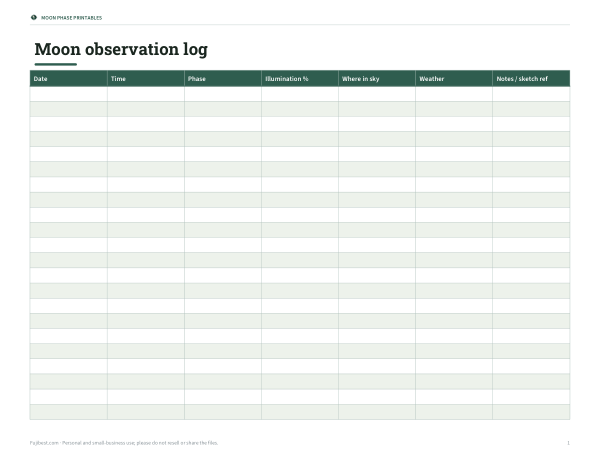
- Observation log (XLSX)
- Journal page (PDF)
Formats: PDF, DOCX, XLSX. Instant download after payment (link valid 72 hours, up to 5 downloads). AI-assisted: the templates were drafted with AI help and reviewed and laid out before publishing.
$3.00 USD, one-time 4 files · about $0.75 each
- Instant download
- 7-day refund
- Secure checkout by Stripe
7-day money-back guarantee. Full refund within 7 days of purchase, even after you download.
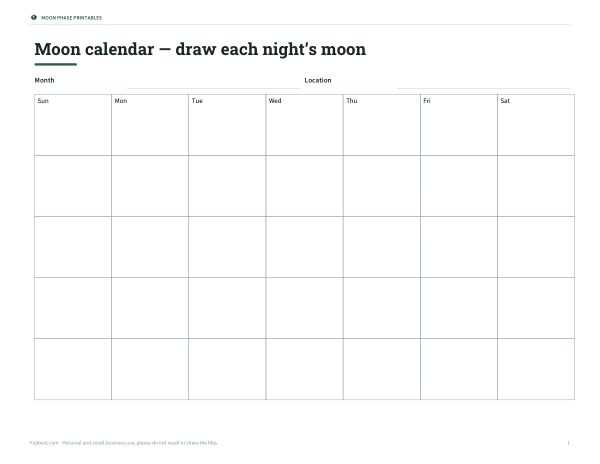
Free sample: Monthly Moon Calendar (PDF, 53 KB)
Full refund within 7 days — see the refund policy and license.
Free printables
Single sheets you can print right now, no sign-up. The full pack adds every sheet in one download plus the editable files.
 Printable Moon Journal Page
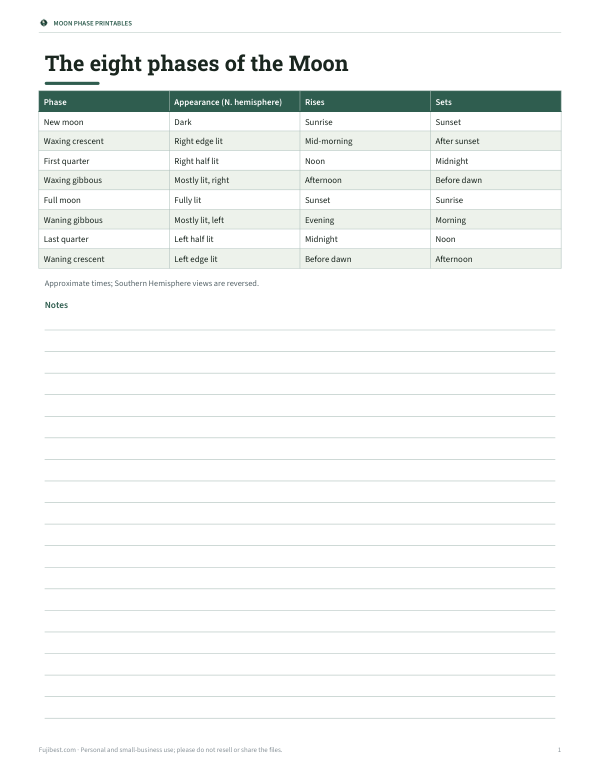
The eight moon phases
| Phase | What you see | When it is visible |
|---|---|---|
| New moon | Dark — the lit side faces away | Up during the day, lost in sunlight |
| Waxing crescent | Thin sliver, growing | Evening, after sunset in the west |
| First quarter | Half lit | Afternoon to midnight |
| Waxing gibbous | More than half, growing | Evening to early morning |
| Full moon | Fully lit | All night, rising at sunset |
| Waning gibbous | More than half, shrinking | Late evening to morning |
| Last quarter | Half lit (other half) | Midnight to midday |
| Waning crescent | Thin sliver, shrinking | Before dawn in the east |
Why the Moon has phases
The Moon has no light of its own; we see sunlight reflecting off it. As the Moon orbits Earth, the angle between the Sun, Earth and Moon changes, so we see different amounts of its sunlit half. From one new moon to the next takes on average 29.53 days — the synodic month — though individual months vary by several hours because the Moon’s orbit is elliptical.
How the chart is calculated
Times of new moon, first quarter, full moon and last quarter are computed with the widely used algorithm from Jean Meeus’s Astronomical Algorithms, including its main periodic corrections, which gives times accurate to within a few minutes for the present era. The phase and illumination for each day are then interpolated between the surrounding new moons. Everything runs in your browser using your device’s clock and time zone.
Northern and southern hemispheres
Observers in the Southern Hemisphere see the Moon “upside down” compared with the north, so the lit side of a waxing crescent is on the left instead of the right. The phase and illumination are the same everywhere on Earth at a given moment; only the orientation changes. Switch the hemisphere setting to see the Moon as it looks where you are.
Using the calendar
- Stargazing — plan around new moon, when the sky is darkest.
- Moon photography — the terminator (day–night line) near first and last quarter shows craters in relief.
- Fishing — many anglers note tides and feeding around new and full moons, when tides are larger.
- Gardening — some gardeners follow lunar planting traditions.
- Night walks and events — full moon gives the most natural light.
Worked example
Opening the chart on a given evening shows the current phase, for example a waxing gibbous moon about 78% illuminated and 10.2 days old. The month calendar shows each night’s disc at 9 pm, and the phase list gives the exact local times of the full moon and the following last quarter — useful for booking a dark-sky weekend around the next new moon.
Moon phases and tides
Around new and full moon, the Sun and Moon pull along the same line and produce larger “spring” tides, with higher high tides and lower low tides. Around first and last quarter, their pulls partly cancel, giving smaller “neap” tides. Local geography modifies the effect, so check a tide table for your coast, but the phase calendar is a useful guide to when big tides are likely.
Moonrise and moonset through the month
The Moon rises about 50 minutes later each day on average. A new moon rises and sets with the Sun, so it is invisible; a first-quarter moon rises around noon and sets around midnight; a full moon rises around sunset and sets around sunrise; a last-quarter moon rises around midnight and is visible in the morning sky. That is why evening skywatchers see a growing crescent after new moon, while early risers see the waning crescent before dawn.
Moon names and traditions
Many cultures name full moons by season — names such as Harvest Moon (the full moon nearest the autumn equinox) and Hunter’s Moon come from North American and European folk traditions. Lunar calendars in many religions and cultures fix festival dates by the Moon’s phases, such as the start of Ramadan or the date of Lunar New Year and Easter.
Photographing the Moon
- Use a tripod and a telephoto lens (200 mm or longer) or a phone with manual controls.
- The Moon is bright: start around ISO 100, f/8 and 1/125–1/250 s, then adjust.
- Shoot near the terminator around first and last quarter for dramatic crater shadows.
- A rising full moon near the horizon looks large next to landmarks — plan with the calendar.
- Focus manually on the Moon’s edge.
Blue moons, supermoons and eclipses
A “blue moon” is popularly the second full moon in a calendar month, which happens roughly every two to three years. A “supermoon” is a full moon near the Moon’s closest approach to Earth (perigee), appearing slightly larger and brighter. Eclipses happen only at new moon (solar) or full moon (lunar) when the Sun, Earth and Moon line up closely with the Moon’s orbital nodes. This chart shows phases; check eclipse listings for eclipse visibility in your area.
Privacy
All calculations happen on your device. No location is used or stored.
Frequently asked questions
What phase is the Moon today?
The chart shows today’s phase, illumination and age based on your device’s clock.
How long is a lunar cycle?
About 29.53 days from new moon to new moon on average.
How accurate are the phase times?
Within a few minutes, using standard astronomical formulas.
Why does the Moon look different in the Southern Hemisphere?
It appears rotated, so the lit side is reversed.
When is the best time for stargazing?
Around new moon, when moonlight doesn’t brighten the sky.
Does the chart use my location?
No, only your device’s time zone.